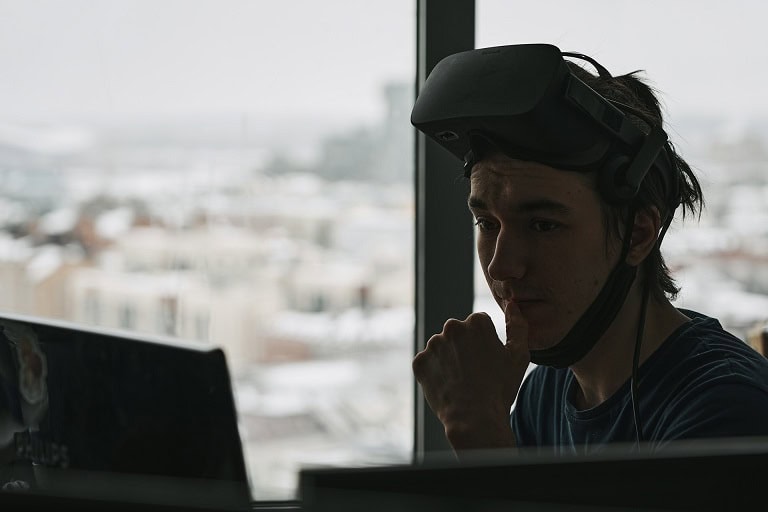
The first time someone straps on a virtual-reality headset, the reaction is usually the same: surprise, excitement, and a brief moment of confusion. Sight, sound, and sometimes touch are rewritten on the spot, forcing the brain to decide whether this new world is real enough to trust. That decision triggers a chain of neural adjustments that researchers are only beginning to map.
From Amusement to Adaptation
At the start, VR feels novel — a quick thrill that sits next to arcade memories or late-night Toonibet Ontario slots on a bright screen. Yet, with repeated use, the headset stops being a toy and becomes a space the brain starts treating as another room. This shift is far from trivial. It involves perception, balance, memory, and even emotion.
Vision Learns to Compromise
VR delivers images a few centimeters from the eyes, yet convinces users they are looking at distant mountains or towering buildings. To accommodate that illusion, the visual cortex recalibrates depth cues. Over several sessions, studies show a drop in the time needed for the eyes to refocus after removing the headset. The brain slowly learns to keep two depth maps — one for the headset, another for the physical room.
Balance Gets Rewritten
Motion in VR often conflicts with signals from the inner ear. The result can be nausea, sometimes called “sim sickness.” Repeated exposure, however, teaches the vestibular system to down-weight conflicting data. Within a week of daily play, many users report far fewer symptoms. In effect, the brain decides the headset’s visual story matters more than the ear’s warning bells.
Key Neural Changes Observed so Far
- Reduced visual–vestibular conflict — the brain learns which cues to trust.
- Faster spatial updating — users locate virtual objects more quickly over time.
- Enhanced proprioception — some studies note better awareness of limb position, even without visual confirmation.
- Altered time perception — minutes inside VR often feel shorter than the clock suggests.
- Emotional blunting of fear — controlled exposure reduces real-world phobias in therapeutic settings.
These adaptations show how flexible adult brains remain, even when faced with technology they never evolved to handle.
Memory Treats VR Like Reality
Episodic memory — the system that stores events — does not fully distinguish between virtual and physical experiences. People asked to recall details from a VR demo days later often remember locations and objects as vividly as real-world landmarks. fMRI scans reveal comparable activity patterns in the hippocampus, the brain’s spatial hub, for both environments.
Trade-Offs Worth Noting
- Attention Shifts
- Users may find flat-screen tasks dull after immersive play.
- Dream Content
- VR scenes sometimes leak into dreams, similar to new real-world locations.
- Spatial Bias
- Heavy VR users occasionally misjudge room dimensions right after removing the headset, a sign of lingering adaptation.
These effects usually fade within minutes or hours, but they remind us that neural plasticity cuts both ways.
Social Circuits and Presence
VR can trick the brain into feeling genuine social presence. When another avatar makes eye contact or gestures, mirror-neuron systems activate almost as strongly as they do face-to-face. This response underpins virtual meetings and therapy sessions where participants report real emotional connection, even when graphics remain stylized rather than photorealistic.
Long-Term Questions Researchers Still Ask
While short-term adaptation is well documented, scientists are probing deeper concerns:
- Will extensive VR use reshape navigation areas in the brain?
- Could constant exposure dull sensitivity to body cues outside VR?
- How will mixed-reality workspaces affect multitasking networks over decades?
Answering these questions requires longitudinal studies that have only just begun.
Practical Tips for Healthy Adaptation
- Limit marathon sessions — frequent short breaks help the vestibular system recalibrate.
- Vary environments — switching between calm and dynamic scenes keeps sensory tuning flexible.
- Use room-scale when possible — real walking reduces mismatch between vision and balance.
- Finish with grounding tasks — simple stretching or mindful breathing brings awareness back to the physical world.
These habits encourage the brain to treat VR as one context among many, not a dominant replacement.
Conclusion: A Brain Built for Change
Virtual reality may seem futuristic, yet the brain adapts to it with the same tools it uses for every new environment — plasticity, pattern recognition, and sensory weighting. The more time people spend in headsets, the more seamless the transition becomes. Understanding that process helps designers create safer, richer worlds and helps users navigate them with confidence instead of confusion. In the end, VR is less about escaping reality and more about expanding what the mind can accept as real — one neural adjustment at a time.